.svg)

Effective Exhibition Management Strategies for Driving Impact and Engagement
In a hyper-competitive marketing landscape, face-to-face events remain one of the most valuable arenas for B2B companies. Trade show participation accounts for 35% of the average B2B marketing budget, demonstrating its significant strategic value. Yet, merely showing up is no longer enough. To capture attention and drive measurable ROI, your exhibit must evolve from a simple display of products into a narrative-driven experience.
This shift defines modern trade show marketing: moving beyond static brochures and generic pitches to tell a compelling story that connects instantly and emotionally with the attendee. At Blues N Coppers, we’ve seen that design and logistics succeed only when they’re powered by story.
Trade Show Marketing: The Story-Driven Imperative
So, what is trade show marketing? At its core, it is the strategic effort to generate leads, build brand awareness, and drive sales pipeline growth by exhibiting at industry events. The traditional approach often focused purely on product features and data sheets. However, research clearly shows that facts alone are ineffective: people only remember 5–10% of information when presented as raw data, but they remember 65–70% when that information is framed within a cohesive story.
A story-driven trade show marketing strategy is not about fiction; it is about conveying your brand’s purpose, highlighting the customer’s challenge, and positioning your solution as the transformative element in a three-act structure:
- The Inciting Incident (The Problem): What critical challenge is your audience facing?
- The Journey (The Solution): How does your product or service tackle that challenge?
- The Resolution (The Transformation): What is the positive, measurable outcome for the customer?
This narrative structure transforms your booth from a passive showcase into an active chapter of your customer’s success story, which is why 55% of consumers are more likely to remember a brand if it tells a compelling story. Blues N Coppers strategists often help brands distill complex identities into single-sentence narratives that guide every design decision.
Part I: The Foundational Strategy—Developing Your Core Narrative
The execution of your exhibit is only as strong as the story that underpins it. Before a single design element is sketched or a piece of technology is rented, your team must define a precise, high-impact narrative.
Step 1: Defining the Protagonist (The Audience) and Their Pain Point
Every great story needs a protagonist, and in trade show marketing, that is your ideal customer. You must define their needs, motivations, and the primary obstacle—or "villain"—they are currently facing.
- Instructional Action: Move beyond demographics (e.g., "B2B decision-makers") to psychographics. What are their goals (e.g., increasing efficiency, reducing compliance risk, scaling operations)?
- Narrative Focus: Your story must start with empathy. Articulate the pain point clearly in the booth experience. If your solution reduces production waste, your story starts with the marketing challenge of waste and inefficiency. If it simplifies complex software, the story begins with the frustration of a convoluted user experience.
- Key Insight: A remarkable 82% of trade show attendees hold buying authority. They are not just browsing; they are actively seeking solutions. Tailoring your narrative directly to their specific buying stage and challenge dramatically increases your chances of generating a qualified lead.
Step 2: Crafting the Central Theme (The Big Idea)
The central theme, or "The Big Idea," is the single message you want every visitor to walk away with. It must be concise and memorable.
- Instructional Action: Write your theme as a single, powerful sentence. Examples:
- Instead of: "We offer cloud-based logistics software."
- Try: "We make global supply chains predictable."
- The Power of Emotion: Brands that use emotional storytelling see a 44% higher ROI than those that rely purely on rational content. Ensure your theme taps into aspirational emotions (e.g., success, security, innovation, relief).
- Narrative Consistency: This theme must be the anchor for all your subsequent trade show marketing efforts, from the pre-show email campaign to the design of the booth's carpet and lighting.
Step 3: Mapping the Visitor Journey (The Story Arc)
A physical trade show exhibit is a physical manifestation of the story arc. Visitors should enter the Beginning (problem), move through the Middle (solution), and arrive at the End (customer success).
.png)
Part II: Bringing the Story to Life—A Six-Pillar Instructional Guide
Executing a narrative-driven trade show marketing strategy requires meticulous attention across six critical pillars.
1. Architectural Design and Environment
The physical design is the stage for your story. It sets the mood, directs traffic, and dictates the pace of the visitor experience.
- Instructional Focus: Use lighting and materials to reinforce your brand's emotional tone. A brand focused on sustainability should use raw, recycled, or natural materials. A tech innovator should use clean lines, futuristic lighting, and digital surfaces.
- Traffic Flow as Pacing: Design the exhibit to encourage a deliberate, one-way path through your story. Avoid a central cluster point that creates bottlenecks. An attendee spends an average of 5.5 hours at a live event; your goal is to maximize their focused dwell time within your exhibit by guiding their journey.
- The Enticement: The primary reason 92% of attendees visit a trade show is to explore new and exciting products. Your exterior visual elements must promise novelty, utility, or a fresh perspective on an old problem. This is where high-impact graphics and compelling visual cues are paramount.
2. Interactive Technology and Engagement
Modern trade show marketing examples rely heavily on technology, not just for flash, but for deeply personalized data capture and narrative delivery.
- Instructional Focus: Integrate technology that requires participation, not just passive viewing.
- Interactive Story Walls: Use large touchscreens that allow visitors to navigate personalized case studies. A visitor from the healthcare sector should be able to filter content to see only healthcare-specific success stories.
- Gamified Learning: Implement a quiz or challenge related to the industry pain point. The outcome of the game can serve as the lead-capture mechanism, and the prize (e.g., a personalized report) serves as the first piece of personalized content.
- The Data Point: Every interaction should feed back into your CRM. If a visitor spends three minutes on your "Cost-Saving Calculator," your sales team should receive an alert that includes that specific interaction detail, allowing for a highly personalized and efficient follow-up. This is an essential step in a solid trade show marketing strategy.
3. Content Strategy: The Narrator’s Script
Content is the spoken and visual script of your story. It should prioritize clarity and emotional resonance over encyclopedic detail.
- Instructional Focus: Less is More: In a high-stimulus trade show environment, long blocks of text are ignored. Use headlines that frame the outcome, not the feature.
- Feature: "Our product includes 256-bit encryption."
- Narrative: "Sleep easy knowing your data is unbreakable."
- The Role of Social Proof: Integrate customer stories and success metrics directly into the content displays. Showcase before-and-after scenarios where your solution provided the transformative Resolution defined in your story arc. Real-life customer testimonials add credibility and emotional weight to your narrative.
4. Staff Training: The Storytellers
Your booth staff are the most critical element of the entire exhibit; they are the living, breathing storytellers. Generic sales training is insufficient.
- Instructional Focus: Train staff to listen and qualify before pitching. Their goal should be to understand which chapter of the story the visitor is currently in (e.g., early-stage research, late-stage buying decision) and adapt the narrative accordingly.
- Empathy and Dialogue: Staff should be trained to open with problem-focused questions, not product features.
- Instead of: "Can I tell you about our new software?"
- Try: "What's the single biggest headache in your workflow right now?"
- Efficiency: Converting a trade show lead is demonstrably more cost-effective. It is 38% less expensive to convert a trade show lead than to rely on sales calls alone. Furthermore, meeting a prospect face-to-face at a trade show event costs about $142 per meeting, which is significantly less than the $250 it costs to meet a prospect at their office. Investing heavily in staff training is an investment in reducing your cost per acquisition.
5. Pre-Show and Post-Show Integration (The Sequel)
The trade show itself is merely the climax of your trade show marketing strategy; the real return on investment (ROI) is generated in the pre- and post-show phases.
- Instructional Focus (Pre-Show): Use targeted emails and social media campaigns to give key prospects a "sneak peek" of the story they will experience at the booth. This builds anticipation and justifies their visit.
- Instructional Focus (Post-Show): Follow-up must be immediate and context-specific.
- Segmentation: Segment leads based on their interaction with your story (e.g., "Visited the Innovation Lab," "Used the ROI Calculator").
- Personalization: The first post-show email should reference the specific part of the story they engaged with. If they viewed the testimonial video, send them the full case study. This moves beyond generic "It was great meeting you" emails and maintains the narrative connection.
6. Measurement and Reporting: The True Metric of Success
Measuring success goes far beyond collecting business cards. A robust trade show marketing strategy requires tracking specific KPIs that reflect engagement with your story.
- Instructional Focus: Go Beyond Foot Traffic:
- Dwell Time: Use heat mapping or beacon technology to measure the average time visitors spend in your key narrative zones (Problem, Solution, Conversion). A longer dwell time in the Solution/Conversion zones indicates higher engagement with the core story.
- Lead Quality vs. Quantity: Track the conversion rate from a booth visitor to a sales-qualified lead (SQL). A 200–400% ROI is considered a strong return on exhibition investment; focusing on story quality ensures that the leads generated contribute to this robust financial return.
- Post-Show Recall: Implement a short, confidential post-show survey asking attendees which booth they remember most vividly and why. If the answers consistently reference your core narrative ("The company that solves X problem by doing Y"), your storytelling effort was successful.
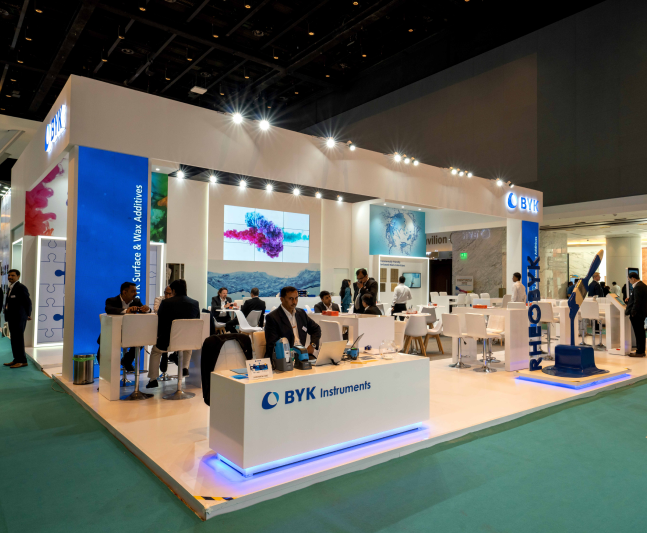
BNC’s booth designers often translate abstract brand stories into physical structures that guide visitors through emotional beats.
Part III: Advanced Trade Show Marketing Examples and Techniques
To truly master the instructional approach, look at advanced methods that blend the physical and digital narratives.
Leveraging the Power of Micro-Experiences
In large trade show settings, attendees are overwhelmed by choice. Break your main story down into several smaller, self-contained micro-experiences—mini-stories that can be consumed in three to five minutes.
- Instructional Action: Dedicate four distinct kiosks to four different customer personas (e.g., the CFO, the CTO, the Marketing Director, the Operations Manager). Each kiosk should tell the same brand story, but from that persona's perspective, focusing on the specific outcomes relevant to their role (e.g., cost savings for the CFO, integration stability for the CTO).
Designing for Dialogue, Not Monologue
The goal of your trade show marketing strategy is not to deliver a lecture; it is to spark a conversation. The exhibit design should include elements that are intentionally incomplete without staff interaction.
- Instructional Action: Use a digital display that starts with a provocative industry statistic (e.g., “70% of businesses struggle with data integration”). When a visitor approaches, the system requires a staff member to scan a badge or enter a code to reveal "The Solution." This forces the conversation to start, ensuring that the staff member is needed to complete the narrative loop.
- The Human Connection: Remember, 90% of trade show attendees have not met the exhibiting company face-to-face in the 12 months before the event. The trade show is a rare and valuable opportunity to initiate a personal, human dialogue that builds trust and loyalty.
Integrating Sustainability as a Core Story Element
Modern audiences, especially in the B2B sphere, value corporate responsibility. If sustainability is part of your brand, it should be a central character in your trade show marketing story, not just a footnote.
- Instructional Action: Use a materials story. Design the entire booth using only modular, reusable, or recyclable components. Have a small, highly visible display that uses QR codes to share the "material journey"—showing where the wood, metal, or fabric was sourced and how it will be recycled or reused for your next trade show. This narrative demonstrates genuine corporate values and aligns with the 92% of businesses planning to be more sustainable when exhibiting.
Focusing on the Long-Term Relationship: The Epilogue
A great trade show marketing strategy looks beyond the immediate lead count. It aims to create brand advocates and long-term customers.
- Instructional Action: Design the final conversion area of your booth to feel like a comfortable lounge rather than a transaction counter. This signals a shift from a sales pitch to a professional partnership discussion. The story should end not with "Buy our product," but with "Let’s start building your future success story."
The Lasting Value of Storytelling in Trade Show Marketing
The future of trade show marketing is fundamentally narrative-driven. By treating your trade show exhibit as an immersive, three-dimensional story, you achieve powerful differentiation, significantly boost attendee recall, and drive a stronger, more predictable ROI. It is the crucial integration of architectural design, immersive experience, highly trained staff, and intelligent post-show planning that maximises the impact of your trade show marketing strategy.
For businesses looking to transition from generic exhibits to narrative masterpieces, partnering with a creative booth design firm is the essential next step. Unlock your brand’s full potential and create an end-to-end trade show marketing strategy that resonates deeply, ensuring your presence is not just seen, but felt, and ultimately, remembered. Partner with Blues N Coppers to transform your next exhibit into a story-led experience that drives measurable impact.
FAQs on Trade Show Marketing
- What is trade show marketing, and why does storytelling make it more effective?
- Trade show marketing is the strategic planning and execution of exhibiting at industry events to generate leads and awareness. Storytelling is vital because it shifts the focus from product features to customer outcomes, enhancing memorability: people recall 65–70% of a story compared to 5–10% of raw data.
- How can a strong trade show marketing strategy influence buyer decisions beyond the booth?
- A powerful trade show marketing strategy extends its influence by generating qualified leads that cost 38% less to convert than traditional sales calls. By providing a memorable, emotionally connected experience, it builds trust and brand loyalty that shortens the sales cycle post-event.
- How to apply emotion-driven approaches in trade show marketing?
- Apply emotion-driven approaches by framing your product as the solution to a frustrating challenge (relief/success) or connecting your brand to aspirational values (inspiration/trust). Brands using emotional storytelling have reported a 44% higher ROI than those relying purely on rational content.
- How is trade show marketing different from traditional event advertising?
- Traditional event advertising is static and broadcast-only (e.g., banners, program ads), whereas trade show marketing is a dynamic, face-to-face interaction channel that allows for immediate, personal dialogue and highly specific qualification of leads.
- How do digital tools extend the impact of trade show marketing after the event?
- Digital tools like CRM integration and lead-capture apps allow exhibitors to segment leads based on their specific booth interactions (e.g., which demo they viewed), enabling immediate, personalized follow-up emails and content delivery that maintains the narrative momentum.
- How does integrating sustainability enhance modern trade show marketing strategies?
- Integrating sustainability, such as using modular, reusable materials or highlighting eco-friendly initiatives, aligns your trade show marketing strategy with the values of modern B2B buyers. It demonstrates corporate responsibility and provides an authentic story, as 92% of businesses now plan for more sustainable exhibiting.