.svg)

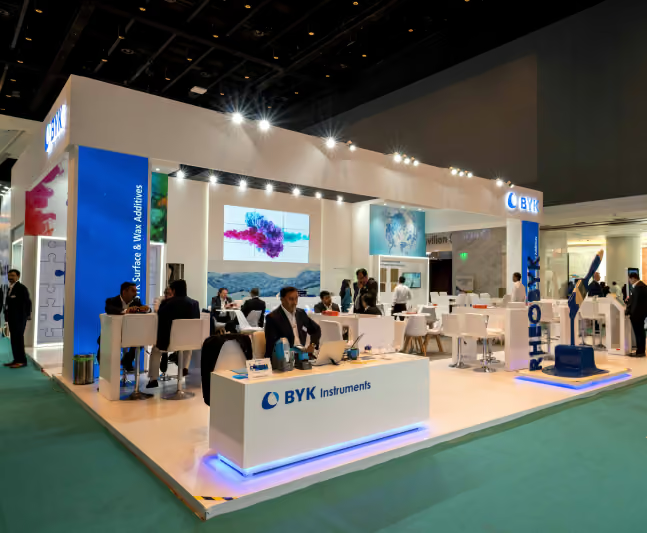
If you've ever walked through a trade show, you know the truth: some booths pull you in without trying, and others disappear even with all the noise, lights, and gimmicks.
It’s never just about having a bigger structure or flashier screens. A space that makes people stop, look, and think, “Okay, this feels different,” always wins. That feeling doesn’t happen by accident. It comes from design choices that are rooted in how people actually move, behave, and connect in a busy exhibition hall.
Why Trade Show Booth Design is Crucial for Success
A great trade show booth design is your first impression, and in a fast-moving exhibition hall, that first impression is often the only chance you get. Before anyone steps foot inside, the design signals who you are, what you stand for, and whether you’re worth their time. That’s where engagement truly begins.
Good trade booth design directly affects foot traffic, dwell time, and visitor perception. A booth with clear sightlines, warm lighting, and a defined visual anchor naturally pulls people in. One with cluttered displays and confusing messaging repels them just as quickly.
For example, a skincare brand using soft gradients and product-forward lighting instantly feels approachable, while an industrial-tech brand using bold lines and sharp contrasts communicates precision and reliability. Different industries, same rule: design shapes expectation.
Across trade shows, the booths that consistently attract the most visitors are the ones that balance aesthetics with function. A visually striking structure means little if people can’t navigate it. Likewise, a highly functional layout won’t work if it looks forgettable. The sweet spot is where beauty and usability meet — intuitive pathways, considered spacing, right-sized displays, and visuals that tell a clear story.
At Blues N Coppers, we’ve learned that the most successful booths don’t try to do everything. They commit to one strong brand idea and let every design decision orbit around it. Considering that they only spend 3-5 seconds while glancing at booths, this clarity becomes a measurable advantage. From open, conversational layouts to bold structures that pull eyes from across the hall, the objective remains constant: design that speaks before you do.
And once you’ve nailed the fundamentals of first impressions, the real game begins. Standing out in a hall where hundreds of brands are trying to do the exact same thing. That’s where creativity, storytelling, and smart design choices become your biggest differentiators.
How to Make Your Trade Show Booth Stand Out
When every design decision feels intentional, not loud, you’re already playing a different game. When you think about how to make your trade show booth stand out, focus on elements that create visual intrigue the moment someone turns into your aisle. Unusual shapes, layered structures, or modular forms instantly shift the booth’s silhouette and break the sameness of the surrounding stalls.
Lighting plays a huge role in shaping that first moment. Warm glows create familiarity, cool tones hint at innovation, and pattern lighting can subtly guide visitors’ eyes across the space. Pair this with textured materials — matte surfaces, fabric panels, wood grains, or metallic accents — and the booth gains depth and character. Digital displays add motion, helping your narrative unfold without demanding attention.
These are small decisions, but they change how people feel as they approach.
A standout booth comes from combining these sensory cues. The shape creates curiosity. The lighting sets the mood. The textures create tactility. The visuals tell the story. When everything works together, visitors naturally gravitate toward it.
Once the structural and sensory elements set the stage, the next layer that shapes the visitor experience is the visual language you use. Graphics and branding are often the first “conversation” your booth has with someone, long before a team member steps in.
Integrating Graphics and Branding into Booth Design
Graphics are one of the strongest tools in trade show booth design because they communicate identity instantly. A single visual — a product close-up, a bold headline, a hero graphic — can convey personality, tone, and purpose in a second, especially in a crowded hall where attention is a limited resource.
Placement and visibility matter just as much as the graphics themselves. Eye-level messages pull people in from the aisle, while elevated visuals help your booth stay recognisable from a distance. Consistent colour schemes build familiarity, and a clear visual hierarchy ensures visitors know what to notice first. When brands use colour, typography, and imagery cohesively, the booth feels unified rather than patched together.
According to a 2023 Freeman and CEIR report (as cited in a field study), 64% of trade show attendees say a booth’s visual appeal is a decisive factor in whether they stop to engage.
Visual branding is often where the story becomes tangible. At Blues N Coppers, we look at how a trade show booth graphic can guide attention, support messaging, and create recognition — not just within the booth, but across the entire exhibition hall. The strongest graphics don’t decorate; they direct, explain, and anchor the entire experience.
Optimising Layout and Flow for Visitor Engagement
After visuals draw people in, a strong trade show booth design decides how visitors move, pause, and engage. A well-planned entrance sets the tone, while thoughtful trade booth design uses sightlines to guide people toward hero products, demo stations, and conversational pockets. Product displays work best when they double as markers along the journey — an attention-grabbing hero unit upfront, hands-on demos placed a little deeper, and seating alcoves that encourage longer discussions.
Visitor flow shapes behaviour. Curved pathways spark exploration and create moments of serendipity; linear paths support structured storytelling or tech-led demonstrations. Elements like motion graphics, tactile samples, or ambient lighting along these pathways increase dwell time because people instinctively slow down when something invites interaction. Wide corridors reduce hesitation; tighter pockets foster focused conversations.
Examples span industries: a wellness brand using a circular layout to promote free movement and sampling; a tech exhibitor arranging staggered screens to create a natural progression of discovery.
Blues N Coppers approaches layout as behavioural choreography. We analyse how people instinctively navigate tradeshow exhibit design environments and place cues that turn casual footsteps into deeper interest and meaningful dialogue.
Choosing the Right Booth Designer for Your Trade Show
Choosing a trade show booth designer is ultimately about choosing the mind that will interpret your brand in three dimensions. The strongest designers share a few defining traits:
They Think in Systems, Not Surfaces
Experienced designers understand that a booth is an ecosystem. They evaluate circulation, ergonomics, line-of-sight dynamics, material behaviour, and technical integration long before aesthetic decisions even surface.
They Decode Brand Behaviour
A good designer reads a brand the way an architect reads a site — its constraints, personality, and functional imperatives. They translate tone and intent into spatial cues that influence how visitors move, interact, and remember.
They Bring Multidisciplinary Intelligence
The best minds pull from retail design, environmental psychology, visual communication, and fabrication engineering. This blend ensures the booth isn’t just beautiful but operationally sound and cognitively intuitive.
They Prototype Ideas, Not Just Render Them
Expert designers test sightlines, lighting temperatures, and user pathways through mockups, VR walkthroughs, or scaled sketches. Their process is iterative, evidence-based, and grounded in real user behaviour.
They Understand Constraints as Design Material
Budget, space, regulations, and logistics aren’t obstacles — they are parameters that sharpen creativity. A seasoned designer can articulate the trade-offs behind every decision.
They Have a Documented Impact
Instead of showcasing only “pretty booths,” they can explain how design choices affected footfall, engagement density, demo completions, and lead quality across different industries.
At Blues N Coppers, our teams operate with this rigour. We approach trade booth design through research, behavioural mapping, and technical precision, ensuring every design choice is intentional and measurable in its impact.
In the 12,000 sq ft Schindler University campus, Blues N Coppers translated Schindler’s core values — innovation, precision, and people development — into a physical space that inspires and orients new engineers. The design uses bold 3D lettering, large wall graphics, and interactive kiosks to create an immersive environment that reinforces Schindler’s identity while guiding trainees through a meaningful onboarding journey.
Measuring Trade Show Booth Success
Once the booth is built and the show floor opens, the real test begins: Did the design work? Measuring trade show booth success goes far beyond counting leads. It starts with baseline metrics — visitor foot traffic, dwell time around key displays, and the number of meaningful interactions your team records. These indicators reveal whether your trade show booth design actually pulled people in and encouraged them to stay.
Equally important is qualitative insight. Observing how visitors navigate the space, where they pause, what they ignore, and what they photograph tells you more about engagement than any spreadsheet. Post-event feedback, both from attendees and your own team, helps identify which design choices added value and which need refinement.
At Blues N Coppers, we evaluate booth performance the same way we design it — through behaviour. We map engagement patterns, study interaction hotspots, and connect them directly to layout, graphics, and experience flow. That loop of insight is what elevates the next booth from good to unmissable.
FAQs
1. What is trade show booth design?
Trade show booth design is the strategic process of creating a branded physical space that attracts attendees, communicates your message clearly, and supports your business goals at an exhibition.
2. How can I make my booth stand out?
Keep one clear message, use strong visuals, stay open and inviting, and make sure every element feels intentional. Simplicity beats noise.
3. What does a booth designer do?
They take your brand story and build it into a space — planning the layout, visuals, materials, and experience so your booth actually works.
4. How do graphics enhance a booth?
Graphics grab attention instantly. With the right colours, visuals, and messages, they help people understand who you are before they even step in.
5. How to measure booth success?
Track who stopped by, who engaged, the quality of conversations, and what happens after the event. If it moved the right people closer to your brand, it worked.