.svg)

When choosing a home, most people naturally focus on square footage. Larger homes appear more valuable, more comfortable, and better suited to their needs. Yet in reality, a thoughtfully designed 900-square-foot apartment often functions far better than a poorly planned 1,500-square-foot one.
The same assumption frequently appears in exhibitions. Many first-time exhibitors spend considerable time believing that more space automatically leads to better results. However, after years of observing exhibition floors across industries, I've found that some of the busiest and most engaging booths are not necessarily the largest. In many cases, smaller booths outperform larger competitors because they are designed around visitor behaviour rather than footprint alone.
This raises an important question: if larger booths don't always yield better outcomes, what actually determines whether an exhibition space attracts visitors and fosters meaningful business conversations?
The answer lies in the booth layout. Industry research from the Centre for Exhibition Industry Research (CEIR) continues to show that exhibitions remain one of the most effective face-to-face marketing channels, with many attendees arriving ready to evaluate solutions and make purchasing decisions. But attracting attention is only the first step. Converting that attention into engagement depends on how easily visitors can navigate the space, interact with the brand, and move naturally through the booth. This is why successful exhibition stand design is not simply about acquiring more square metres. It is about creating a layout that aligns with visitor flow, supports business objectives, and encourages meaningful engagement.
Why First-Time Exhibitors Obsess Over Booth Size
Trade show planning often begins with a floor plan.
Organisers present exhibitors with options ranging from compact spaces to expansive island booths. Naturally, many exhibitors assume that a larger footprint automatically delivers better results.
There are several reasons for this mindset.
First, the trade show booth size is easy to measure. A larger booth feels like a tangible advantage. More space appears to mean more visibility, more visitors, and more opportunities.
Second, there is a psychological comfort in being bigger. Exhibitors often associate booth size with brand stature. A larger booth can create an impression of market leadership, even before visitors engage with the brand.
Third, larger booths feel safer. Many first-time exhibitors worry about being overlooked, so purchasing more space seems like an insurance policy against invisibility.
However, visitor behaviour rarely follows this logic.
Think of a large retail store with wide empty aisles, limited guidance, and products scattered throughout the space. Compare that with a smaller boutique where every display is intentional, you know how to navigate aisle after aisle, and staff interactions feel natural.
It’s anyone’s guess which store got more visitors.
Let’s Talk Booth Layout
A booth is ultimately a physical environment designed to influence human behaviour.
The layout determines how visitors experience that environment.
When visitors approach a booth, they make rapid decisions:
- Can I enter easily?
- What is this company offering?
- Is there something worth exploring?
- How much time will this require?
The answers are often communicated through the booth design layout rather than signage or marketing messages.
Visitor Flow Patterns
One of the most important factors is visitor flow.
High-performing booths create natural pathways that guide visitors through the experience without forcing them.
Poor layouts often create bottlenecks, dead zones, or confusion.
For example, a large booth with product displays positioned directly at the entrance can unintentionally block movement. Visitors hesitate, crowding develops, and engagement decreases.
Meanwhile, a smaller booth with an open-front design may invite visitors naturally and encourage longer interactions.
Sightlines and Visibility
Visitors frequently decide whether to approach a booth within a few seconds.
Clear sightlines help them immediately understand what is happening inside the space.
When displays, meeting areas, and engagement zones are visible from the aisle, curiosity increases.
Interaction Zones
Successful layouts intentionally create areas for different visitor activities:
- Product demonstration space
- Informal conversations
- Lead capture points
- Private meetings
- Brand storytelling displays
Each zone serves a specific purpose within the visitor journey.
Dwell Time
The longer visitors remain engaged, the greater the opportunity for meaningful conversations.
Thoughtful layouts encourage exploration and reduce friction.
A visitor who comfortably spends five minutes interacting with products often generates more value than ten visitors who simply walk past.
“Visitor flow patterns that consistently separate high-performing booths from underperforming booths are surprisingly simple,“ points out Viral Momaya, Project manager. “Clear entry points, visual anchors visible from key entry points, activity zones and unobstructed pathways almost always outperform complex layouts.”
Momaya adds, “We've observed several projects where a strategically planned compact exhibition stall design generated stronger lead quality than neighbouring larger booths because the smaller space focused entirely on accessibility, interaction, and conversation.”
Choosing Booth Sizes and Layouts Based on Business Goals
One of the most common planning mistakes is selecting space before defining objectives.
Effective exhibition booth planning works in the opposite direction.
The first question should be:
What do you want visitors to do?
Once that answer is clear, the appropriate layout becomes easier to identify.
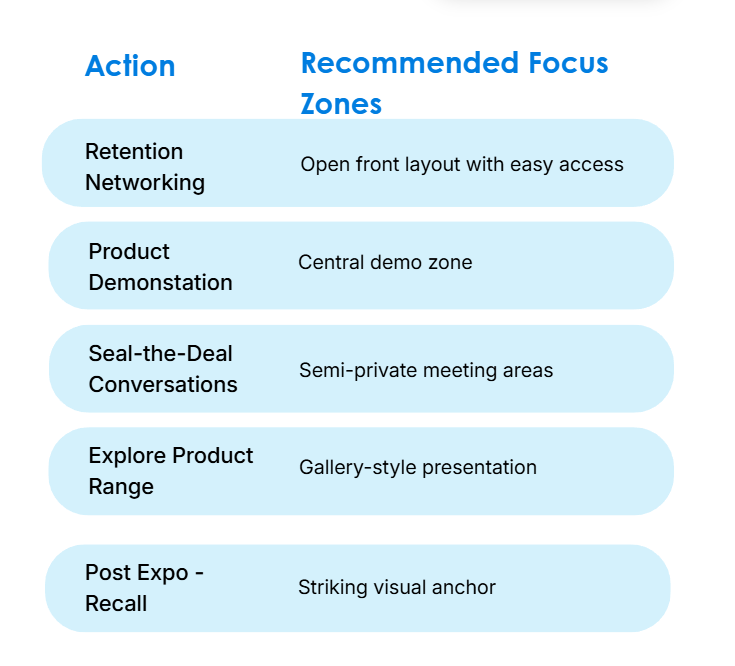
1. Retention Networking: Creating Easy Conversations
If your primary objective is to strengthen relationships with existing customers, distributors, partners, or industry contacts, the booth should feel welcoming rather than structured.
In this scenario, visitors already know your brand. The goal is not to educate them extensively but to create opportunities for meaningful interaction. An open-front layout with minimal physical barriers allows visitors to enter naturally and start conversations without feeling pressured.
Comfortable seating areas, coffee counters, and informal discussion spaces often work better than elaborate product displays. The emphasis should be on accessibility and relationship-building.
2. Product Demonstration: Making the Product the Centre of Attention
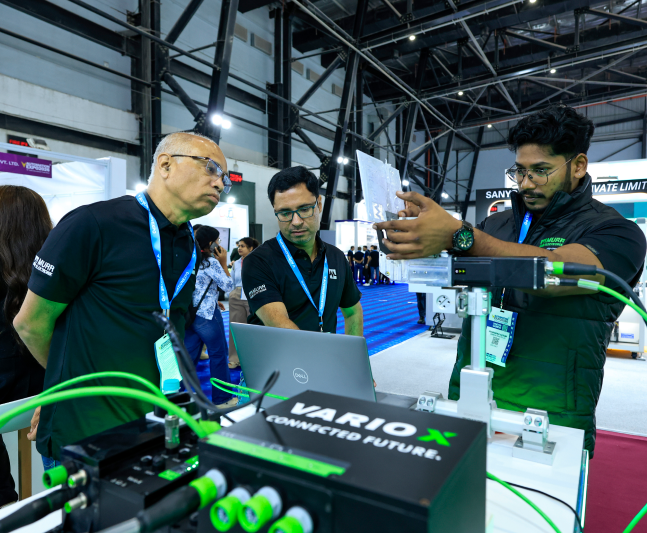
When launching a new product or showcasing a complex solution, demonstrations often become the most important activity within the booth.
Visitors need enough space to gather, observe, ask questions, and interact with the product. This makes a central demonstration zone essential. Rather than placing products around the booth perimeter, the layout should naturally guide visitors toward a focal point where presentations can occur throughout the day.
For technology, machinery, healthcare, and industrial brands, the demonstration area often becomes the highest-performing zone because it transforms passive visitors into active participants.
3. Seal-the-Deal Conversations: Supporting Serious Business Discussions
Not every exhibition interaction is about awareness. In many B2B exhibitions, visitors arrive with purchasing intent and are ready for detailed discussions.
When lead conversion is the priority, the booth must provide spaces where conversations can move beyond introductions. Semi-private meeting areas create an environment where pricing, technical specifications, partnership opportunities, and procurement discussions can happen comfortably.
Without dedicated meeting spaces, important conversations often get interrupted by surrounding noise and traffic, reducing the likelihood of meaningful outcomes.
Many experienced exhibitors allocate a significant portion of their booth footprint to meeting rooms because they understand that business decisions rarely happen in crowded aisles.
4. Explore Product Range: Encouraging Discovery
Brands with large product portfolios face a different challenge. Instead of focusing visitors on a single solution, they need to help attendees understand the breadth of their offerings.
A gallery-style layout works particularly well in these situations. Products can be grouped into categories, application areas, or industry solutions, allowing visitors to explore at their own pace.
This approach transforms the booth into a guided journey rather than a single-point interaction. Visitors move from one section to another, discovering new products while building a broader understanding of the brand's capabilities.
Industries such as manufacturing, consumer goods, building materials, and technology often benefit from this format because they need to showcase variety without overwhelming visitors.
5. Post-Expo Recall: Making the Brand Memorable
Sometimes the objective is simple: ensure visitors remember your brand long after the exhibition ends.
In crowded exhibition halls, visibility and memorability become critical. A booth designed for post-event recall prioritises visual impact through bold architecture, distinctive branding, creative lighting, suspended structures, or immersive experiences.
The goal is not merely attracting visitors but creating a mental image that stays with them after the event. When attendees later review suppliers, discuss exhibitors with colleagues, or follow up on potential opportunities, your booth should be one of the first brands they remember.
Strong recall is often achieved through a combination of striking design, consistent messaging, and a unique visitor experience.
While business objectives determine the type of zones your booth requires, the layout itself influences how visitors move, engage, and interact within those zones. Factors such as visitor flow, circulation paths, and space allocation can significantly affect booth performance. For a deeper look at how different exhibition layouts shape visitor behaviour and engagement, explore our detailed guide on how to choose the best layout.
Common Mistakes First-Time Exhibitors Make
One of the most common assumptions first-time exhibitors make is that a bigger booth automatically leads to better results. In reality, exhibition success is rarely determined by square footage alone. What often matters more is how effectively the space supports visitor engagement, conversations, and brand storytelling. Over the years, we've observed that exhibitors who focus on clarity and functionality tend to outperform those who simply focus on scale.
1. Choosing the Largest Booth the Budget Allows
A larger booth may seem like a strategic advantage, but it also introduces greater complexity. More space requires additional staffing, larger budgets for fabrication and graphics, and a stronger visitor engagement plan. Without a clear purpose for every square metre, larger booths can feel empty and dilute the visitor experience.
2. Ignoring Visitor Circulation
An exhibition booth should guide visitors naturally, much like a well-designed retail store. When circulation paths are overlooked, visitors may feel unsure where to enter, where to stop, or how to interact with displays. Clear movement patterns encourage exploration and create more opportunities for meaningful engagement.
Navin Chandwani, founder of Blues N Coppers shares, “Visitors rarely follow the route exhibitors expect. Designing around natural movement patterns almost always creates better engagement than forcing a specific path.”
3. Overcrowding Displays
Many first-time exhibitors try to showcase every product, service, and message in a single space. The result is often visual overload. Visitors leave remembering very little because too much information competes for their attention. Focused messaging and carefully selected displays typically create stronger recall and better conversations.
4. Underestimating Storage Requirements
Storage is one of the most overlooked elements of booth planning. Promotional materials, product samples, personal belongings, refreshments, and operational equipment all need a designated place. Without built-in storage, clutter quickly accumulates and undermines an otherwise professional presentation.
5. Skipping Goal Definition
Every exhibition booth should be designed around a clear objective. Some exhibitors prioritise lead generation, while others focus on product launches, networking, or brand awareness. When goals are not defined early, design decisions become arbitrary, making it difficult to measure success once the event concludes.
6. Creating Barriers to Entry
High counters, enclosed walls, and complicated layouts can unintentionally discourage visitors from entering the booth. The most effective exhibition spaces feel welcoming and accessible. Open layouts, visible activity, and clear entry points make participation feel effortless.
7. Prioritising Aesthetics Over Functionality
A visually impressive booth can attract attention, but functionality determines whether that attention converts into meaningful engagement. Meeting areas, product demonstration zones, storage, visitor flow, and staff positioning all contribute to the overall experience. Great design attracts visitors; practical design helps achieve exhibition objectives.
When Does Trade Show Booth Size Actually Matter?
Booth size becomes important when your exhibition objectives require activities that need dedicated space.
The question is not whether a larger booth is better. The real question is whether your business goals demand more room to achieve them effectively.
For example, if your objective is simply to network with existing customers or maintain brand visibility, a compact booth with an open layout may be more than sufficient. On the other hand, if you plan to conduct live product demonstrations, showcase large equipment, host multiple client meetings, or create immersive brand experiences, additional space quickly becomes a necessity rather than a luxury.
Booth size typically matters most when you need to accommodate:
- Multiple visitor activities simultaneously
- Large product or machinery displays
- Semi-private meeting rooms for business discussions
- Hospitality lounges for key clients and partners
- Interactive demonstrations or experiential activations
- Higher visitor volumes without creating congestion
However, additional space only creates opportunities. It does not automatically create engagement.
Visitors do not enter a booth because it occupies more square metres. They engage when the environment feels inviting, the experience is relevant, and the layout makes interaction easy.
We've often seen smaller booths outperform larger ones because every square foot was planned with a clear purpose. Likewise, oversized booths without a defined visitor journey can feel empty, confusing, or difficult to navigate.
A useful way to think about it is this:
Booth size should be a response to your strategy, not the starting point of it.
The most successful exhibition booths are the ones where the available space, regardless of size, is aligned with the business outcomes the exhibitor wants to achieve.
Why Simplicity Often Wins
One of the most valuable lessons from years of exhibition planning is that simplicity frequently outperforms complexity. Limited space can actually become an advantage because it forces exhibitors to focus on what truly matters: clear messaging, purposeful design, and meaningful visitor interactions. When every element serves a specific objective, even a modest booth can deliver results that rival much larger spaces.
Successful Booths Are Planned, Not Just Bigger
Booth size matters.
There is no denying that additional space creates opportunities for visibility, demonstrations, meetings, and brand experiences.
However, size alone rarely determines exhibition success.
What consistently drives engagement is a thoughtful booth layout that supports visitor behaviour, aligns with business objectives, and creates meaningful interactions.
The most effective exhibition stand design projects begin by understanding what visitors should experience, not simply how much space is available.
When booth size, visitor flow, functionality, and exhibition goals work together, the result is a booth that performs efficiently regardless of footprint.
At Blues N Coppers, we approach exhibition planning as a strategic exercise rather than a purely creative one, helping brands align booth size, layout decisions, visitor journeys, and business outcomes.
If you're planning your next exhibition and want guidance on choosing the right booth layout and size for your goals, connect with our expert team for strategic booth planning insights.
Frequently Asked Questions
1. Does a larger trade show booth always generate more leads?
No. Larger booths can attract attention, but lead generation often depends more on visitor experience, accessibility, and engagement strategy than booth size alone.
2. What is the most effective booth layout for first-time exhibitors?
Open-front layouts are often effective because they reduce barriers to entry and encourage natural visitor interaction.
3. How do I choose the right booth size for my exhibition goals?
Start by defining your objectives. Product demonstrations, meetings, lead generation, and brand awareness each require different space and layout considerations.
4. What are the biggest booth planning mistakes exhibitors make?
Common mistakes include prioritising booth size over strategy, ignoring visitor flow, overcrowding displays, and failing to define clear exhibition goals.
5. How can a small exhibition stand design compete with larger booths?
By focusing on visitor flow, clear messaging, strong sightlines, and meaningful interactions, smaller booths can often outperform larger competitors.
6. What should be prioritised first: booth size or booth layout?
Booth layout should typically come first. Once business goals and visitor journeys are defined, selecting the appropriate booth size becomes much easier.