.svg)

It's a common habit, isn’t it?
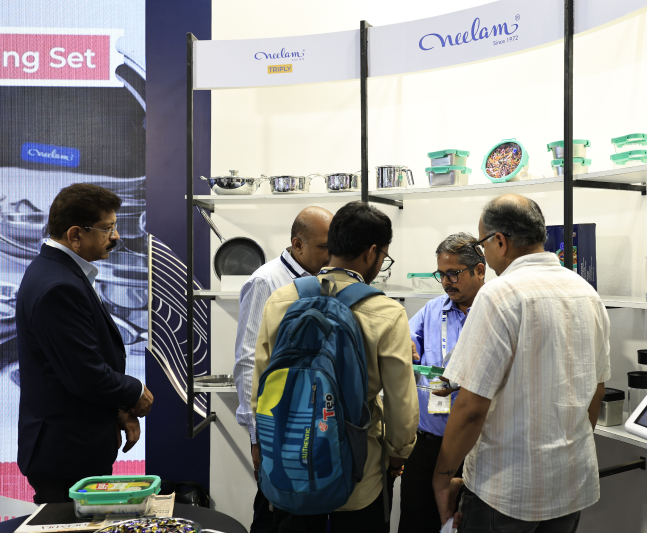
To walk through a tradeshow and see what your competitors' booths look like every time you participate in a tradeshow. You come across spaces packed with machines, components, and technical displays. Everything looks important, yet nothing tells you where to begin, what the story is.
This is how most industrial exhibitions function. Manufacturers invest significant time and resources to showcase their complete product portfolio, but in trying to display everything, they often make it harder for visitors to find what they're actually looking for. On the other hand, showing the entire product catalogue is important since it’s a combined decision of stakeholders.
So, how do you showcase hundreds of products without overwhelming your audience or leaving valuable solutions undiscovered?
The answer lies in the strategic arrangement of products to tell a story. The most effective industrial exhibition booth guides visitors through a journey built around their business challenges. By combining strategic exhibition booth design with thoughtful product hierarchy, intuitive navigation, and solution-led storytelling, even the largest product portfolios become easier to explore. Let's explore how industrial brands can make that shift and create exhibition experiences that are both comprehensive and visitor-centric.
Why Industrial Booths Become Product Catalogues
When marketers discuss improving an industrial exhibition booth, one piece of advice appears repeatedly:
"Display fewer products."
While well-intentioned, this advice rarely reflects the reality inside industrial organisations.
For many manufacturers, displaying a comprehensive product range isn't simply a design choice. This then becomes a business requirement.
A single exhibition booth often represents multiple divisions, regional sales teams, distributors, and product managers, each responsible for different product lines. Leadership may want flagship innovations highlighted, while engineering teams expect technical credibility. Sales representatives need enough products on display to support conversations with different customer segments, and recently launched products often come with mandatory visibility targets.
Before long, every department has a valid reason for including "just one more product."
This is the natural outcome of balancing competing business priorities. However, the real challenge lies elsewhere.
Most industrial exhibition booths organise products exactly the way the company itself is structured:
- Motors
- Pumps
- Compressors
- Sensors
- Valves
- Controllers
This makes perfect sense internally because employees understand their own product hierarchy.
Visitors don't.
They aren't thinking in departments or product categories. They're thinking about solutions that will solve production delays or operational efficiency.
When an exhibition booth mirrors an internal organisational chart instead of a customer's decision-making process, visitors are forced to translate technical categories into business solutions themselves. That extra effort often becomes the point where attention is lost.
Rather than asking, "How can we display fewer products?" a better question is:
"How can we help visitors quickly find the products that matter most to their business?"
That subtle shift changes the entire purpose of booth design.
Visitors Don't Think Like Your Product Team
Industrial buyers enter an exhibition with a problem already occupying their mind. Knowing this psychology changes how an effective B2B exhibition booth design should be planned.
Attendees make rapid decisions about which booths deserve further exploration, often within the first few moments of noticing them. With hundreds of exhibitors competing simultaneously, visitors rely on quick visual cues to decide where to spend their limited time.
When every product receives the same visual weight, like similar shelving, identical signage, dense technical specifications, and competing graphics, the brain has no obvious starting point.
Instead of creating curiosity, the booth creates cognitive overload.
Look at the way people browse streaming platforms. Thousands of films may be available, but viewers aren't presented with one giant alphabetical list. They're guided through categories such as "Because You Watched...", "Trending," or "Recommended for You." The experience is organised around relevance, not inventory.
Industrial exhibitions should work in much the same way.
Visitors need guidance before they need information.
They want to recognise that your company understands their industry challenges before they explore the technical details behind individual products.
This is where many successful industrial exhibitors begin shifting from displaying products to telling solution-led stories. Instead of asking visitors to decode an extensive catalogue, they create a journey that makes discovering relevant solutions feel intuitive.
The result is an aesthetic booth that’s also functional. It creates more meaningful conversations, higher-quality engagement, and a visitor experience that feels purposeful rather than overwhelming.
Shift 1: Organise Around Customer Problems, Not Product Categories
Instead of organising your industrial exhibition booth around product categories, organise it around the challenges your customers are trying to solve.
For example, instead of marking your products under:
- motors,
- pumps,
- valves, and
- compressors.
Consider creating application-focused zones such as:
- Reduce Downtime
- Increase Productivity
- Improve Energy Efficiency
- Factory Automation
- Predictive Maintenance
Within each zone, visitors can discover multiple products that work together to solve a business problem rather than seeing them as isolated pieces of equipment.
This approach mirrors how industrial buying decisions are actually made. Rarely does one product solve a challenge in isolation. Buyers are evaluating systems, workflows, compatibility, and long-term outcomes.
An application-based layout also naturally encourages cross-selling. A visitor exploring predictive maintenance may discover sensors, monitoring software, vibration analysis tools, and automation equipment that they might never have noticed if the products were displayed in separate departmental sections.
More importantly, stories are easier to navigate than catalogues.
People instinctively understand narratives because they provide context. A visitor who enters a "Reduce Downtime" zone immediately knows why they're there and what value they can expect. The booth begins to answer questions before anyone from the sales team has started a conversation.
This simple change transforms the role of exhibition booth design from displaying inventory to guiding discovery.
Shift 2: Create Hero Products That Lead the Journey
Think of a museum.
Visitors don't walk into a gallery where every artefact is treated as the centrepiece. Curators carefully select hero exhibits that capture attention first, while supporting displays add depth and context. The journey feels intentional rather than overwhelming.
Industrial exhibitions should follow the same principle.
Every booth should have a small number of hero products that immediately communicate the company's strengths. These might be flagship machines, breakthrough innovations, or solutions that represent the broader portfolio.
These hero products perform several important roles:
- Capture attention from the aisle.
- Spark initial conversations.
- Demonstrate innovation.
- Represent broader solution categories.
Once visitors engage with these centrepieces, supporting products can naturally extend the discussion.
For instance, a manufacturer exhibiting a fully automated packaging line doesn't need to physically display every compatible motor, controller, gearbox, or sensor. Instead, the main system becomes the focal point, while supporting technologies are introduced during conversations or through digital tools.
This is where product hierarchy becomes essential.
Rather than assigning equal space to every product, consider structuring your portfolio like this:
Hero Products
- Major innovations
- High-impact demonstrations
- Signature machinery
Supporting Products
- Complementary equipment
- Accessories
- Components
- Spare parts
Digital Catalogue
- Complete portfolio
- Technical documents
- Specifications
- Product configurators
Visitors still gain access to your entire product range, but they aren't expected to process everything at once.
Digital catalogues, touchscreen interfaces, and QR-enabled brochures ensure that detailed information remains available without physically crowding the booth.
Instead of removing products, you're prioritising attention.
And attention is one of the most valuable resources at any trade show.
Shift 3: Layer Information Instead of Displaying Everything
Industrial companies are understandably proud of their technical expertise.
Specifications, engineering drawings, certifications, material grades, operating pressures, flow rates, tolerances, and compliance standards all matter, especially during the buying process.
The mistake is assuming they all matter immediately.
Visitors rarely begin with technical specifications.
They begin with a simple question:
"Why should I care?"
This is where progressive disclosure becomes one of the most effective strategies in industrial trade show booth design.
Rather than presenting every detail simultaneously, information should unfold in layers.
Layer 1: The Headline
Capture attention with a simple promise or business outcome.
Examples:
- Reduce Downtime by 30%
- Cut Energy Consumption
- Improve Production Accuracy
- Automate Repetitive Tasks
This answers the visitor's first question: What’s in it for me?
Layer 2: The Business Benefit
Provide a short explanation that connects the product to measurable operational value.
For example:
"Predict machine failures before they interrupt production."
or
"Reduce maintenance costs through continuous monitoring."
Now visitors understand why they should continue exploring.
Layer 3: Product Demonstrations & Interactive Experiences
Once visitors understand the value, give them a reason to stay.
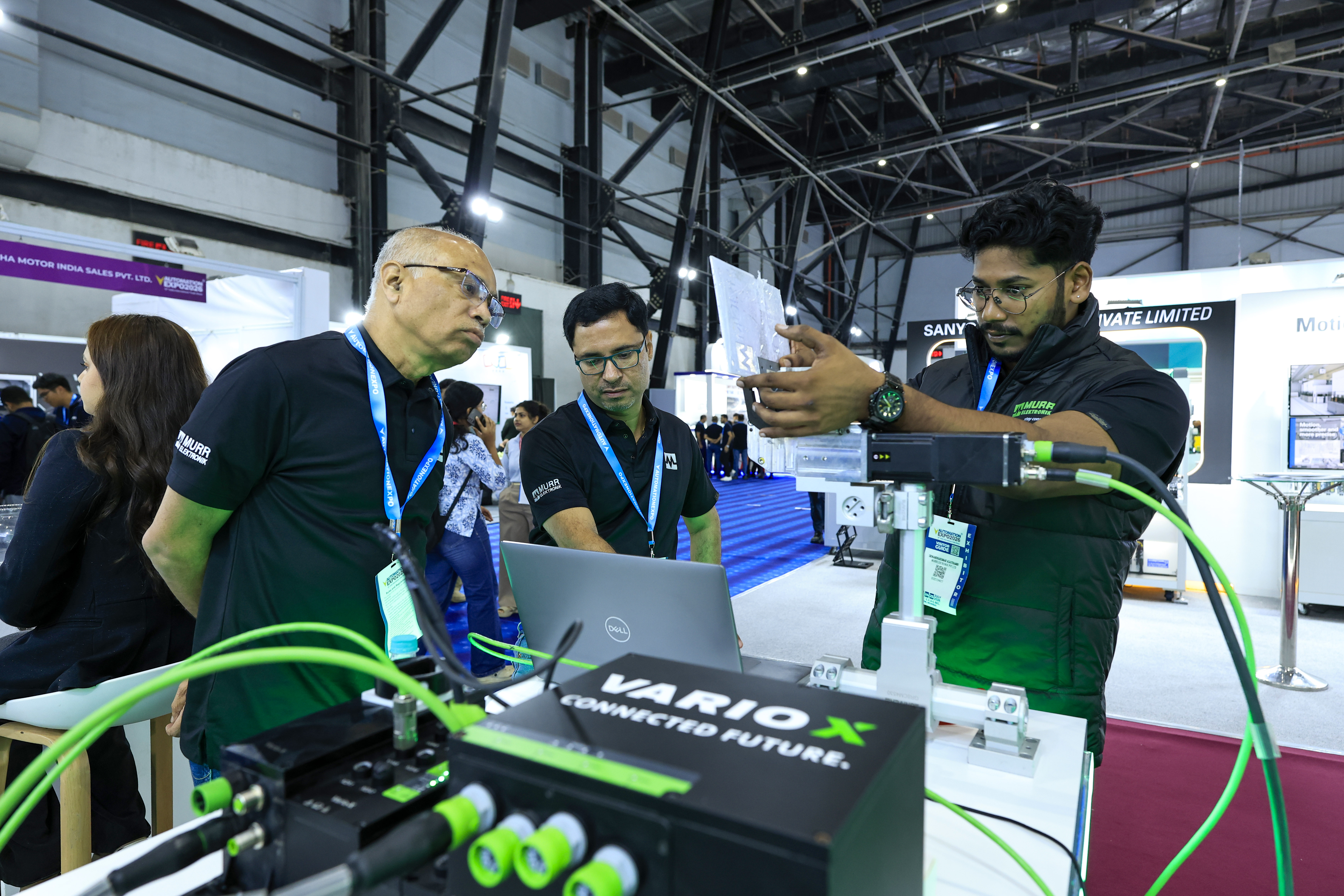
This is where live product demonstrations and interactive experiences become powerful. Rather than asking visitors to imagine how a solution works, let them experience it firsthand.
This could include:
- Live machine demonstrations
- Interactive touchscreens
- Digital product configurators
- Hands-on product trials
- Industry-specific simulations
The longer visitors engage with your solution, the more likely they are to ask questions, remember your brand, and begin meaningful conversations. Interaction transforms passive observers into active participants.
Layer 4: Expert Conversations
Once visitors are engaged, connect them with the right people.
Instead of directing them to specification sheets immediately, introduce them to product specialists or technical experts who can understand their specific challenges.
A meaningful conversation often begins with questions like:
- What production challenge are you trying to solve?
- Where are you experiencing downtime?
- What are your current process limitations?
Only after understanding the visitor's requirements should the discussion move into technical details such as performance data, certifications, material specifications, compatibility, or engineering capabilities.
Technical information becomes far more valuable when it is presented as the answer to a real business problem, rather than as a wall of data. This approach creates more relevant conversations, builds trust, and helps visitors see how the solution fits their specific application.
Shift 4: Design Navigation, Not Storage
An effective exhibition booth layout should never feel like walking through a warehouse.
Yet many industrial booths are designed primarily to maximise the number of products displayed, leaving visitors to search for what interests them.
Storage and navigation are very different design goals.

The second question almost always creates a better visitor experience.
Good navigation starts before someone even enters the booth.
From metres away, visitors should already understand what the booth offers through clear overhead messaging and application-focused branding.
Once inside, intuitive wayfinding continues the journey.
Some practical techniques include:
Overhead Signage
Large suspended signs allow visitors to orient themselves even within crowded exhibition halls.
Instead of searching for individual products, they can immediately head towards the solution area most relevant to them.
Application Zones
Create distinct environments around industries or customer challenges instead of departments.
Each zone tells a complete story through products, graphics, demonstrations, and customer outcomes.
Interactive Product Finder
Touchscreen kiosks or searchable digital interfaces allow visitors to locate products based on:
- Industry
- Application
- Product type
- Operational challenge
Rather than replacing physical displays, these tools make large portfolios far easier to explore.
QR-Enabled Catalogues
Not every technical document needs to be printed.
QR codes can link visitors directly to:
- Technical data sheets
- CAD files
- Product videos
- Installation manuals
- Case studies
- Digital brochures
This reduces visual clutter while ensuring detailed information remains only a scan away.
Most importantly, navigation should support visitor flow.
Visitors should naturally move from one solution area to another, discovering relevant products as they progress. Comfortable meeting pods, interactive demonstrations, and open sightlines encourage people to pause, engage, and continue exploring without feeling trapped in a maze of equipment.
The goal is simple: the booth should feel like a well-designed experience to explore.
When navigation becomes part of the design strategy, even companies with hundreds of products can create an experience that feels organised, purposeful, and remarkably easy to understand.
A Real-World Example: When Many Products Need to Feel Like One Story
The challenge is designing a space where all the products showcased tell the complete brand story.
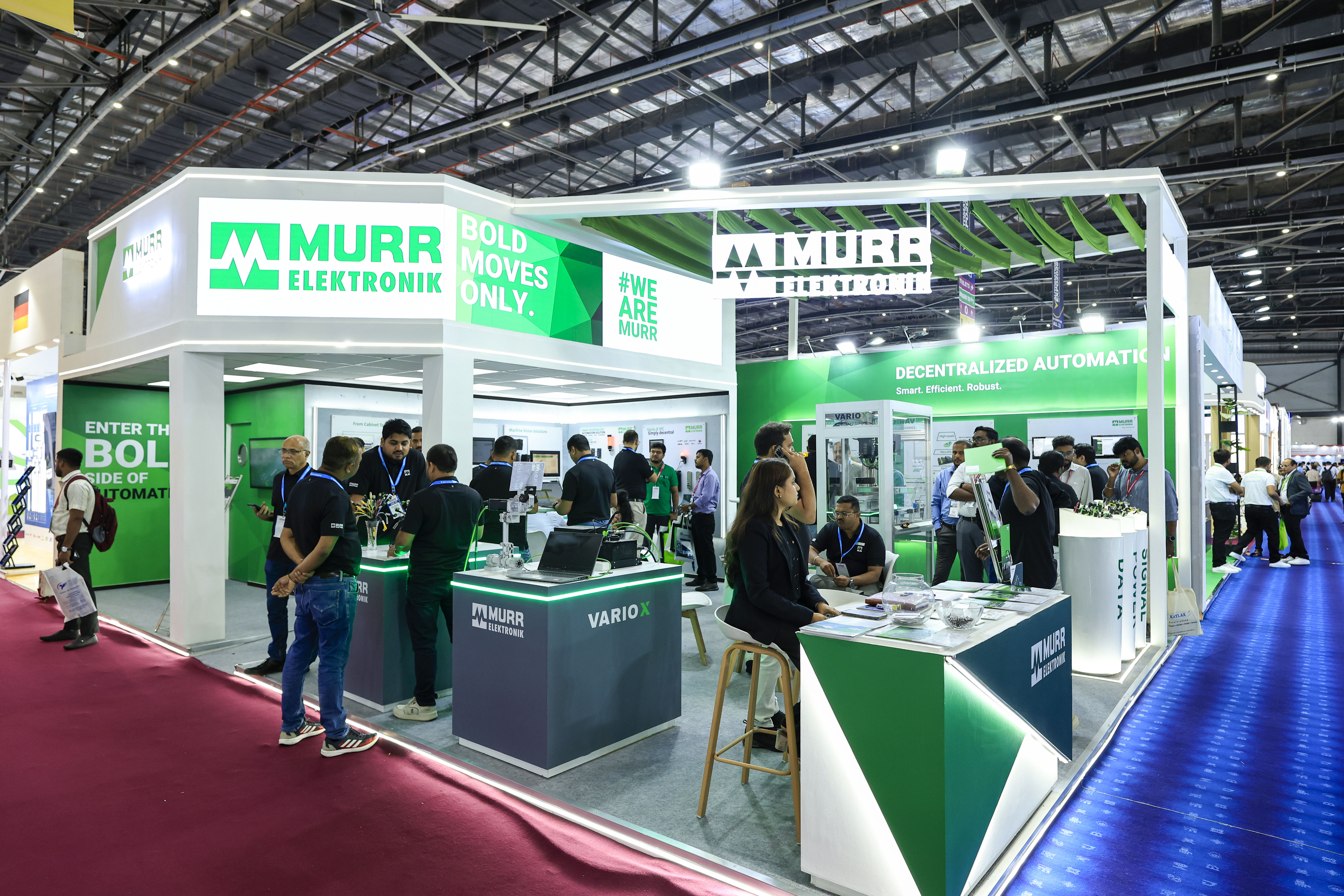
For Murrelektronik at Automation Expo, the objective was exactly that. The 70 Sqm booth was planned to balance extensive product displays with a clear visitor journey. Brand-led architectural elements, interactive experiences, and carefully zoned spaces ensured visitors could discover products within the context of the brand, rather than as isolated items.
The mezzanine created a natural transition from exploration to business conversations, while the ground floor remained open, engaging, and easy to navigate.
The result wasn't a booth with fewer products. It was a booth where the products contributed to a larger brand story. Visitors experienced Murrelektronik's solutions in a structured, intuitive environment instead of feeling like they were walking through a catalogue.
As Viral Momaya, Project Lead at Blues N Coppers, points out, “The point is not to hide complexity, but to organize it into a story that customers can understand.”
Common Mistakes That Turn Industrial Booths into Product Catalogues
Even with the best intentions, many industrial exhibitors unintentionally create experiences that overwhelm visitors rather than engage them. These issues are rarely caused by poor products; they stem from how information is organised and presented.
Giving Every Product Equal Importance
When every product receives the same display space, signage, and visual emphasis, visitors struggle to identify where to begin. Without a clear focal point, attention becomes fragmented.
Leading with Technical Specifications
Engineering details are essential, but timing matters. Presenting specifications before communicating business value can discourage visitors who first want to understand the broader benefit.
Ignoring the Visitor Journey
Many booths are designed around available floor space instead of how people naturally move, explore, and make decisions. Without a logical progression, visitors often leave before discovering the most relevant solutions.
Weak Visual Hierarchy
When graphics, products, lighting, and messaging all compete equally, nothing stands out. Strong visual hierarchy helps visitors understand priorities within seconds.
Organising by Internal Departments
Grouping products according to business units may simplify internal planning, but it rarely matches how buyers think. Visitors care about solving operational challenges, not organisational structures.
Missing the Story Behind the Products
Products communicate features. Stories communicate value.
Without connecting equipment to real-world applications, visitors are left interpreting technical capabilities on their own.
Displaying Every Product Physically
Physical displays are valuable, but they are not always necessary. Digital catalogues, interactive product finders, and QR-enabled documentation can make large portfolios accessible while keeping the booth uncluttered and easy to navigate.
Avoiding these mistakes doesn't require reducing the size of your portfolio. It requires presenting that portfolio in a way that respects how visitors actually consume information.
Integrating Design, Storytelling, and Sales
An effective industrial exhibition booth is rarely the result of design alone.
The strongest exhibition experiences emerge when spatial planning, product strategy, visitor psychology, and sales objectives are developed together rather than in isolation.
Design determines what visitors notice first.
Storytelling helps them understand why it matters.
Sales conversations translate that understanding into meaningful business discussions.
Digital experiences provide access to deeper information without overwhelming the physical space.
When these elements work together, the booth becomes far more than an attractive display. It becomes a guided decision-making environment.
Consider a visitor entering the booth with a general interest in reducing maintenance costs. Instead of being greeted by rows of unrelated machinery, they're directed toward a Predictive Maintenance zone where a hero product demonstrates the solution in action. Supporting products, digital case studies, and technical documentation gradually deepen their understanding, while a nearby meeting space allows the conversation to move naturally from exploration to consultation.
Every element supports the next.
This integrated approach also creates consistency for the sales team. Rather than explaining the company's portfolio from scratch in every conversation, the booth itself begins telling the story before a single question is asked.
Ultimately, great B2B exhibition booth design isn't about fitting more products into a space. It's about creating an environment where visitors can quickly connect their business challenges with the right solutions.
When design provides direction, storytelling creates relevance, and sales builds relationships, the exhibition booth transforms from a static display into a purposeful business experience.
From Product Catalogue to Product Story: The Real Competitive Advantage
Exhibition booths don't fail because they have too many products. They fail when visitors have to figure out the story on their own.
Every product on your booth may deserve to be there. The challenge is presenting them in a way that feels intentional, guides visitors naturally, and helps them understand how your solutions fit their needs. Through thoughtful zoning, clear hierarchy, and a visitor-first journey, even the most extensive product portfolios can become engaging, easy to navigate, and memorable.
If you're planning your next exhibition and wondering how to showcase everything without overwhelming your audience, our team can help. Get in touch with our exhibition design experts to explore how your products can come together in a booth that tells a clear, compelling brand story.
Frequently Asked Questions
1. How can an industrial exhibition booth showcase many products without overwhelming visitors?
Instead of displaying every product with equal emphasis, organise products around customer applications, highlight hero products, and use digital catalogues or QR-enabled documentation to provide access to the complete portfolio. This makes the booth easier to navigate while still showcasing the full product range.
2. What is the difference between a product catalogue booth and a product story booth?
A product catalogue booth focuses on displaying products by category or department, while a product story booth organises products around customer problems and business outcomes. The latter creates a more intuitive experience that helps visitors quickly identify relevant solutions.
3. How should products be organised in a B2B exhibition booth design?
The most effective B2B exhibition booth design groups products according to customer challenges such as energy efficiency, automation, predictive maintenance, or productivity improvements. This aligns with how industrial buyers evaluate solutions rather than how companies structure their internal product lines.
4. What role does exhibition booth layout play in visitor engagement?
A well-planned exhibition booth layout guides visitors naturally through the space using clear zones, visual hierarchy, signage, and interactive touchpoints. Good navigation reduces confusion, increases dwell time, and encourages more meaningful conversations.
5. How can digital tools support large industrial product displays?
Interactive product finders, touchscreen catalogues, QR codes, product videos, and downloadable technical documentation allow exhibitors to showcase extensive product portfolios without overcrowding the booth. Visitors can access detailed information at their own pace while maintaining a clean and organised exhibition space.
6. What should businesses look for when choosing the best exhibition booth company in Mumbai?
Look for a partner that goes beyond fabrication and understands visitor behaviour, product storytelling, spatial planning, and business objectives. The best exhibition booth company in Mumbai should be able to translate complex product portfolios into engaging visitor experiences that support marketing and sales goals—not simply build an attractive booth.