.svg)

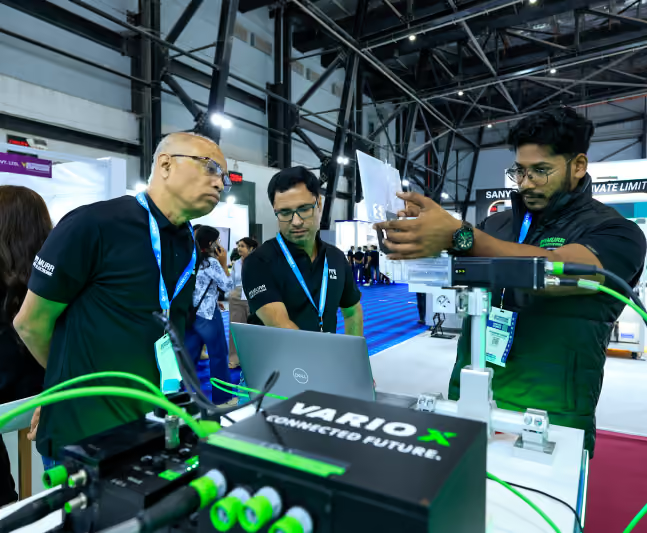
“Can we just put something simple together for the expo?”
That question sounds harmless until the work begins. Because a “simple” booth still needs clear messaging, a functional layout, approvals, fabrication, logistics, and on-site coordination. What looks like a small setup on the surface quickly turns into a complex project with many moving parts.
Exhibition booths are inherently multi-disciplinary and complex.
It begins with a briefing and a clear understanding of why you’re participating and what your brand needs to achieve. Then comes design, where abstract ideas must translate into a physical, human-centric space on a crowded show floor. Alongside this, strategies for lead generation and visitor engagement need to be defined with precision.
Execution follows, and this is a domain of its own. Fabrication, sourcing, installation, and on-ground maintenance all need to align seamlessly, often under tight timelines and constraints.
Each of these functions operates with interdependencies. They overlap. They influence one another. And when alignment slips, confusion follows. Ownership becomes unclear. Small gaps turn into expensive mistakes.
This is where most exhibition projects start to feel overwhelming, and the solution? Having a checklist.
A checklist brings clarity and creates visibility across stages, aligns stakeholders, and ensures that nothing critical slips through.
Building a strong exhibition space is less about quantity of work and more about getting the fundamentals right.
Why Exhibition Booths Often Fall Short
“The most common misalignment, in my experience, often takes place between design and execution. What looks compelling on render doesn’t always work on the show floor,” says Viral Momaya, lead project manager at Blues N Coppers. “A design can idealize impressive concepts without fully accounting for budgets, materials, timelines, or on-ground constraints. By the time installation starts, compromises have to be made, which can dilute the impact of the original idea.”
Another common issue is over-focusing on how the booth looks and under-focusing on what it needs to do. A booth can be visually striking but still fail to attract, engage, or convert visitors if there’s no clear strategy behind it. Messaging is another weak spot. If it’s not clear what you’re trying to say, visitors won’t spend time trying to figure it out. Confusion leads to disinterest.
Then comes visitor flow. If people don’t know where to walk, where to stop, or what to interact with, they move on quickly. Even a well-designed booth can feel awkward if movement isn’t planned properly.
Add last-minute approvals and poor communication between teams, and things start to break down fast - finishing suffers, structures get rushed, and details are missed.
Differentiation Strategy is important.
Most of your competitors focus on showing good-looking booths, but stop there. They offer inspiration, not a way to evaluate what actually works. There are very few structured tools to help teams make better decisions.
Execution quality and build precision are often overlooked, even though that’s where projects succeed or fail. More importantly, design, execution, and engagement are treated as separate steps, not as one connected process.
This gap is where a more practical, system-driven approach stands out.
A Smart Checklist for Building Stronger Exhibition Spaces
Now, a good-looking booth and a well-performing exhibition booth can be vastly different. It usually comes down to a few basics when done right. A good place to start would be focusing on clarity, logic, build, and the intended audience reaction.
Let’s approach this with a 5-point checklist.
1. Brand Clarity: Can People Understand You in Seconds?
At an exhibition, you have 3.7 seconds to make an impression on your visitor and get them to visit your booth. Your booth should visually answer who you are and what you do in that short time frame.
.jpg)
This comes down to clear messaging, strong visuals, and text that can be read from a distance. If someone has to stop and think too much, you’ve already lost them.
2. Spatial Logic: Does Your Booth Guide People Naturally?
A good booth should feel easy to navigate. If the layout is confusing, people won’t explore. Even a great-looking booth can feel uninviting if movement isn’t planned well.
Visitors should know where to enter, where to go, and where to stop without making it too obvious. Different zones, such as product showcases, meeting spaces, or demos, should be clearly defined. This is where spatial design is more useful to build the ideal brand perception.
3. Material Quality: Does Your Booth Reflect Your Brand Standard?
What your booth is made of says a lot about your brand.
The finishes, textures, and small details all add up. Using thinner boards, low-grade laminates, poor edge finishing, or swapping specified materials to cut costs or save time. On paper, these changes seem minor. On the floor, they’re very visible.
This is also where shortcuts often creep in and you can spot quality quickly. Check the edges and joints - are they clean and aligned? Are the surfaces smooth, consistent, and well-finished? Notice how different materials meet - do they feel intentional or patched together?
Good material quality doesn’t have to mean expensive. It means consistent finishes, proper detailing, and no visible compromises. When done right, it makes the booth feel reliable and builds trust instantly.
4. Execution Precision: Is Everything Built As Intended?
This is where many booths fall apart(both literally and figuratively).
What was planned on paper needs to show up exactly on the floor. That means correct sizes, proper alignment, and clean finishing.
Even small mistakes like crooked panels, rough edges, poor lighting stand out quickly. Good execution is what turns a design into a real experience.
5. Engagement Design: Are People Interacting or Just Walking Past?
A booth should invite visitors to do something, not just look at it.
This could be product demos, interactive touchpoints, screens, or simple interactions that keep visitors hooked and encourage deeper engagement with the field team. The goal is to make them to open up more about their product/ service needs so that it’s easier for your sales team to plug in personalized sales pitches.
How to Use This Checklist in Real Projects
A checklist is only useful if you apply it at the right time.
1. Start using checklist before you even begin designing.
Before trying to translate the brief from the boardroom to your drawing board, make a checklist. It helps you stay clear on what matters and avoids rework later.
2. Use checklist again while evaluating vendors.
Don’t just look at cost or past work. Check if they can actually deliver on these five areas: clarity, layout, material quality, execution, and engagement.
You can ask vendors to give you examples of past projects and the thinking behind it in terms or clarity and layout. For material quality, ask what materials they typically use and where they’ve made trade-offs before. If possible, review samples or visit a live/previous booth.
For execution, go deeper. Ask how they handle timelines, last-minute changes, and on-site issues. Request close-up images of finished work, not just wide-angle shots.
You can also give them a small brief and see how they respond. Are they asking the right questions and thinking beyond the brief?
Don’t assume they can deliver. Make them show you how they do it.
3. Bring it back during the on-site build.
Walk through the booth with the checklist in hand. Check if things are being built the way they were planned. Look closely at finishes, alignment, and overall feel.
4. At each stage, the checklist acts like a filter.
Don’t wait till the end to review everything. Use the checklist actively while decisions are being made - while reviewing designs, during production and on site installation.
The idea is simple: use the checklist to question and validate decisions in real time, not after the work is done.This helps you catch issues before they become big.
Download the Full Exhibition Booth Checklist
Here’s a checklist you can use for your next exhibition project. It’s comprehensively designed to help you review ideas, align teams, and catch gaps before they turn into problems on the show floor.
Use it while planning, designing, and building so you stay in control at every stage.
Click on this link to download.
From Checklist to Strategy
While these elements might be separate boxes to tick, they are also connected.
A booth feels strong when everything works together: clear messaging, easy movement, good materials, clean execution, and meaningful interaction. If even one of these is weak, the whole experience starts to break.
For example, a well-built booth won’t help if the message is unclear. A great design won’t work if people don’t know how to move through the space. Good engagement won’t happen if visitors don’t understand what you’re offering.
Strong booths come from cohesion of all the stakeholders and their performed tasks, not individual effort.
Conclusion
Strong exhibition booths are built with intention - by getting a series of small but critical decisions right. Clear messaging helps people understand you instantly. Thoughtful layouts guide movement without confusion. Material choices shape how your brand is perceived. Precise execution ensures what was planned is actually delivered. And well-designed interactions turn passive visitors into engaged prospects.
Individually, each of these elements matters. But their real impact comes when they work together as one system. That’s what separates booths that simply look good from those that consistently perform on the show floor.
If you want to see how this thinking translates into real projects—and how these elements come together in practice—you can explore our work and the solutions behind it.
At Blues N Coppers, we have 15+ years of experience in translating this thinking into real projects and how these elements come together in practice. You can explore our work to see how the experiences were engineered successfully.
FAQ
1. What should be included in an exhibition booth checklist?
Brand clarity, layout/visitor flow, material quality, execution details, and engagement elements.
2. How do I evaluate an exhibition booth design?
Check if the message is clear, movement is intuitive, materials match your brand, and the design is practical to build.
3. What makes an exhibition booth effective?
Clear communication, easy navigation, strong build quality, and interactions that make visitors stop and engage.
4. Why do exhibition booths fail?
Gaps between design and execution, unclear messaging, poor layouts, and rushed or low-quality builds.
5. How do you ensure booth execution quality?
Align design with build early, choose the right vendors, and closely review finishing and details on-site.