.svg)

Most of our exhibition briefs begin with the same intention: “We want to stand out in a crowded hall surrounded by competitors.”
The reality is that’s your competitors’ objective as well. Exhibition halls today are filled with visually polished booths, strong branding systems, immersive screens, and carefully curated displays. Walking through an expo often feels like walking through a premium shopping mall where every storefront is competing for attention through impressive visual merchandising.
So the question becomes: how do you actually stand out in an environment where almost everyone looks so prepared?
One thing our team at Blues N Coppers has observed repeatedly across exhibitions is that the booths generating the strongest engagement are rarely the ones with the most visual noise. They are usually the spaces designed around visitor psychology, movement flow, storytelling, and purposeful interaction. That shift — from simply building a booth to designing an experience — is what defines experiential exhibition design.
What is Experiential Thinking in Exhibition Design?
Experiential thinking is a strategic approach to exhibition design that prioritizes how visitors interact with a space rather than how the booth simply looks from a distance. It moves beyond static layouts and focuses on creating meaningful, memorable engagement.
Strong experiential exhibition design considers:
- Human behaviour before aesthetics
A visually stunning booth may still fail if visitors don’t know where to enter or feel intimidated approaching it. For example, we’ve seen highly polished enclosed booths receive less engagement than open layouts simply because visitors felt more comfortable walking into them naturally. - Memory before decoration
Visitors rarely remember every graphic panel they saw during an expo. They remember moments. A live product interaction, an unexpected sensory detail, or a meaningful conversation often creates stronger recall than expensive decorative elements alone. - Visitor flow before fixtures
Many booths overload the front area with counters, product displays, or demo stations, unintentionally creating traffic bottlenecks. Strong experiential planning studies how visitors naturally move through a space and positions engagement points where people are most likely to pause comfortably. - Purpose before visual clutter
In crowded halls, adding more screens, messages, and graphics doesn’t always improve engagement. In fact, excessive visual stimulation often creates confusion. Booths that communicate one strong idea clearly tend to perform better than spaces trying to say everything at once. - Interaction before passive display
Visitors engage more deeply when they participate rather than simply observe. For example, allowing attendees to test a product, contribute to a live installation, or experience a guided demo usually creates stronger conversations than static displays visitors walk past passively.
This distinction matters because a visually impressive booth does not automatically create a strong visitor experience.
Many exhibition stand designers focus heavily on graphics, structures, or screen installations without considering how attendees naturally move, pause, or make decisions inside a crowded venue. Experiential thinking changes that approach. It asks practical questions such as:
- What should visitors notice first?
- Where should conversations happen?
- What emotional response should the space create?
- How does the environment support the brand story?
In many ways, experiential booth design behaves more like hospitality planning than conventional architecture.
The objective is not just to occupy square footage, but to shape how people experience that space over time.
How to build a Robust Experiential Design Framework
A strong experiential framework is not built around isolated gimmicks or interactive technology alone. It is a structured methodology where branding, psychology, movement, storytelling, and engagement operate together as one system.
Brand Intent Mapping
Before design begins, the first step is understanding the intended visitor outcome.
What should attendees feel, understand, or remember after leaving the booth?
This stage aligns:
- Emotional objectives
- Business goals
- Audience expectations
- Message hierarchy
For example, a medtech brand may want visitors to feel trust and reassurance, while a technology company may prioritise curiosity and innovation. The booth experience should reflect those emotional priorities consistently through materials, lighting, interaction style, and spatial openness.
Without this alignment, booths often become visually impressive but strategically disconnected.
Visitor Psychology
People behave differently inside exhibition environments than they do in retail stores or offices. Attention is fragmented. Decision fatigue is high. Visitors constantly evaluate where to spend their limited time.
Strong exhibition stand builders and strategists account for behavioural patterns such as:
- Curiosity triggers
- Visual anchoring
- Social proof
- Sensory fatigue
- Trust cues
- Comfort zones
For example, open entrances tend to feel psychologically safer than narrow enclosed access points. Interactive elements positioned too close to walkways may create congestion rather than engagement. Even lighting temperature influences whether a space feels welcoming or intimidating.
Experiential thinking studies these small behavioural details because they collectively shape visitor decisions.
Movement & Spatial Flow
One of the most overlooked aspects of experiential design is movement strategy.
Visitors rarely follow exhibition floor plans exactly as intended. Instead, they create “desire paths” which are natural movement routes based on attraction points, visibility, congestion, and comfort.
This is why experienced exhibition booth design company teams pay close attention to:
- Entry friction
- Pause zones
- Visibility corridors
- Dwell areas
- Interaction sequencing
- Visitor circulation
A booth with excellent graphics but poor movement planning can unintentionally create bottlenecks, confusion, or disengagement.
At Blues N Coppers, our teams often map visitor behaviour before finalising layouts because visitor flow frequently shapes engagement outcomes more than decorative complexity alone.
Insiya adds that in her experience so far she has seen mid - sized booths outperform larger premium spaces simply because the movement flow felt natural and intuitive. “People engage longer when they don’t feel forced into the experience.”
Storytelling Architecture
Experiential exhibition design also relies heavily on structured storytelling.
The best exhibition experiences unfold progressively rather than presenting all information at once.
A robust storytelling framework can look like this:
- Attention
The first challenge in any exhibition hall is interruption. Visitors are constantly surrounded by movement, visuals, screens, and conversations competing for their focus. This is why the first layer of experiential thinking is creating an immediate visual anchor that naturally attracts attention without overwhelming the visitor.
Dynamic visuals, strong spatial composition, lighting contrast, suspended elements, or even strategic product placement can create this initial attraction. One thing we’ve observed repeatedly is that visitors rarely stop because a booth is “busy.” They stop because something feels visually clear, intriguing, or emotionally relevant within seconds.
- Discovery
Once attention is captured, the next stage is curiosity.
Many booths immediately overwhelm visitors with brochures, aggressive sales pitches, or too much information upfront. Experiential thinking approaches this differently. Instead of pushing visitors toward the product, the environment encourages them to discover it naturally.
This could mean:
- Interactive product exploration
- Open layouts that invite movement
- Guided pathways
- Layered information zones
- Products positioned in contextual storytelling setups
For example, a technology brand might create a live-use environment instead of displaying isolated products on shelves. Visitors begin exploring because they want to understand how the solution works rather than because someone instructed them to stop.
The psychology here is important: people engage more deeply with things they feel they have “discovered” themselves.
- Interaction
Curiosity alone is not enough. Visitors need an active reason to engage with the brand.
This is where experiential exhibition design shifts from observation to participation. Interaction creates involvement, and involvement creates stronger memory retention.
Effective interaction does not always require complex technology. It simply needs to feel purposeful and human.
This could include:
- Guided demonstrations
- Interactive kiosks
- Hands-on product testing
- Live personalization experiences
- Participatory installations
- Gamified engagement moments
For example, instead of explaining a product through static graphics, allowing visitors to physically test it or customise a feature creates a one-on-one relationship between the visitor and the brand itself.
At this stage, the booth stops behaving like a display area and starts functioning like an experience environment.
- Conversation
Once visitors understand the product or service, the next objective is to create space for meaningful conversation.
One common issue in many booths is that all the attention goes into attraction while very little thought is given to where actual business discussions will happen. Experiential thinking recognises that engagement should eventually transition into comfort and dialogue.
Hospitality zones, lounge areas, semi-private meeting corners, and relaxed seating arrangements encourage longer conversations and emotional warmth. These areas reduce the transactional feeling often associated with exhibitions.
We’ve noticed that visitors tend to stay longer and speak more openly when the environment feels less performative and more welcoming. Even small spatial decisions like softer lighting, acoustic control, or slightly separated seating can significantly improve conversation quality.
In many cases, this is where trust actually begins to build.
- Memory
The final stage of experiential storytelling happens after the exhibition itself.
A strong booth experience creates emotional recall, but follow-up determines whether that memory translates into long-term business value. Surprisingly, this is where many exhibitors lose momentum. Studies suggest that nearly 82% of exhibitors fail to follow up with captured leads within an effective time frame.
Experiential thinking extends beyond the physical booth into post-event engagement:
- Timely follow-up emails
- Personalized recap content
- Event highlight videos
- Product reminders
- Thoughtful conversation continuation
When follow-up is delayed or generic, visitors often forget the interaction entirely because exhibition environments expose them to dozens of competing brands within a short period.
Strong exhibition storytelling ensures that every section of the booth contributes to a coherent narrative rather than functioning as disconnected displays.
Engagement Layering
Many brands confuse technology with engagement. However, adding touchscreens alone does not automatically create experiential value.
Meaningful engagement usually combines multiple layers:
- Sensory interaction
- Guided participation
- Human conversation
- Demonstration-led experiences
- Physical interaction
- Social engagement opportunities
For example, a booth demonstrating industrial equipment may benefit more from tactile material samples and live walkthroughs than from excessive digital screens.
Similarly, outdoor experiential marketing activations often succeed because they create shared participation and emotional involvement rather than passive observation.
The objective is not to overwhelm visitors with activity, but to create purposeful moments of interaction.
How Brand Teams Can Build Experiential Thinking Internally
Before approaching an exhibition stall design company or booth design agency, brand teams should first clarify the strategic experience they want to create.
A strong experiential brief should answer questions such as:
- What visitor emotion are we designing for?
- What should people notice first?
- What interaction should start conversations?
- What friction points might discourage engagement?
- What memory should visitors leave with?
- Is the branding integrated into the experience or simply applied visually?
This process helps brand managers move from tactical booth planning toward strategic visitor engagement design.
It also creates better collaboration with exhibition stand designers because the discussion shifts beyond materials, graphics, and dimensions into behavioural outcomes and business objectives.
Experiential thinking becomes significantly stronger when brands treat exhibitions as relationship environments rather than temporary displays.
Why Experiential Thinking Matters in Modern Expos
Modern exhibitions are highly saturated environments. Visitors are exposed to hundreds of brands, overlapping messaging, product demonstrations, and multiple similar-sounding sales conversations within a few hours.
In that environment, attention becomes selective.
According to the Center for Exhibition Industry Research (CEIR), a 72% of trade show attendees make purchasing decisions or influence buying conversations after live event interactions. However, attention spans inside exhibition halls continue to shrink as sensory overload increases.
This is where experiential marketing principles become important.
Rather than relying only on visibility, experiential exhibition design improves engagement by shaping how visitors interact with the environment itself. A strong booth experience can:
- Increase dwell time
- Improve emotional recall
- Encourage more meaningful conversations
- Create stronger brand differentiation
- Improve lead relevance instead of just lead volume
For example, in one of our collaborations with Grundfos, instead of just keeping technical brochures and static graphics, we installed one interactive wall mount and one interactive kiosk at key visitor flow points. Visitors could either interact with the wall mount or kiosk first and then explore products, or vice versa, and sales support would intercept them only when they were willing to know more about the product and how it can help them.
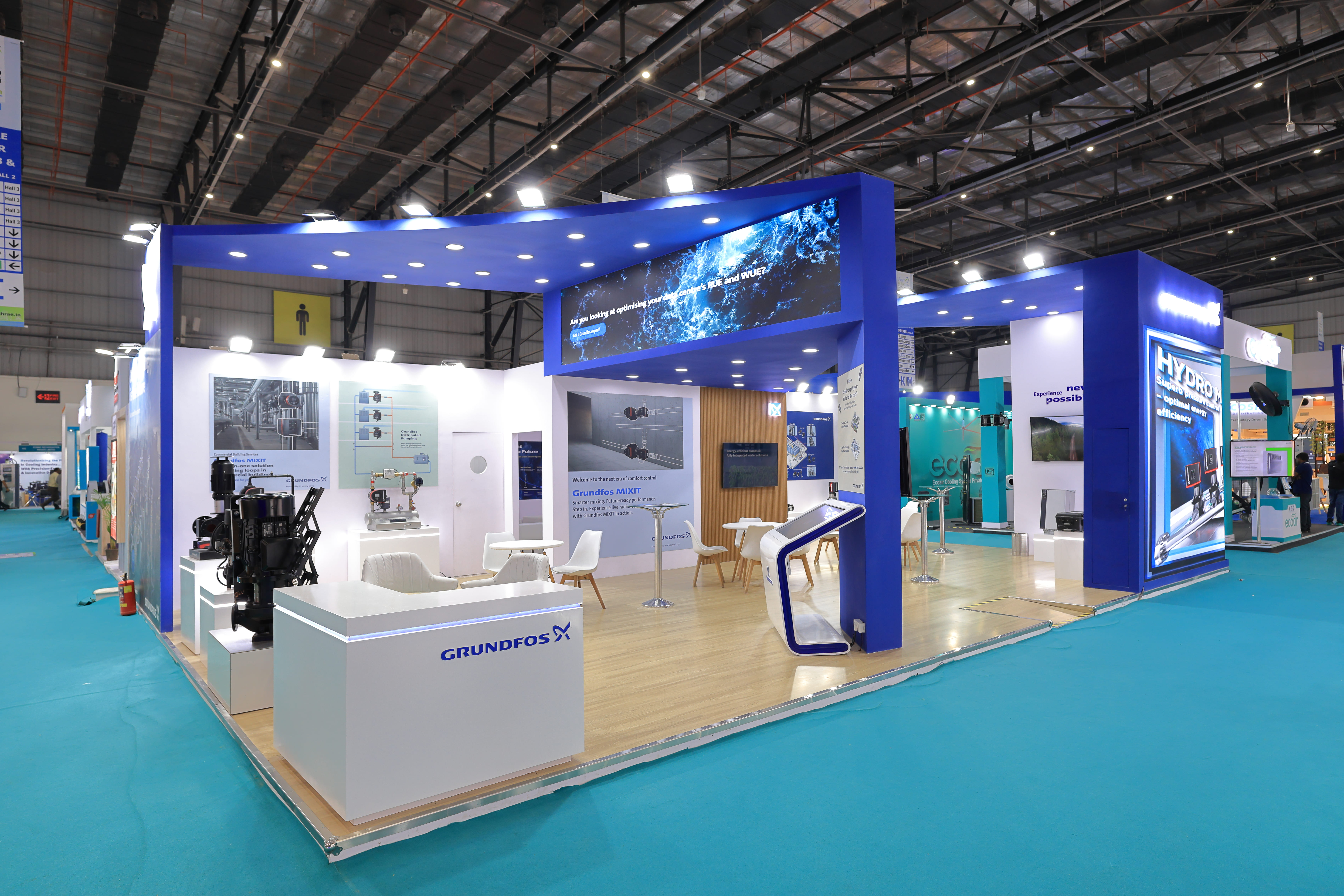
This guides visitors through a short interactive journey with layered storytelling, tactile engagement, and clear visitor movement cues. Visitors may spend the same amount of time at both booths, but the second experience often leads to stronger memory retention and higher-quality conversations.
Our lead exhibition booth designer, Insiya Bootwala, explains, “Visitors rarely remember every specification they saw at an expo. They remember how a space made them feel, how easy it was to engage, and whether the interaction felt purposeful rather than transactional.”
That is the difference between decorative design and experience-led planning.
Common Mistakes in Booth Experience Planning
Even experienced brands sometimes fall into patterns that unintentionally weaken engagement. In many cases, the issue is not a lack of budget or creativity, but a lack of experiential alignment between branding, movement, storytelling, and interaction.
- Creating Unclear Storytelling Journeys
One of the most common mistakes in exhibition design is presenting too much information without a structured narrative. Visitors enter the booth but don’t know where to look first, what the core message is, or how the experience unfolds.
For example, some booths place product demos, digital screens, meeting areas, and branding messages all within the same visual plane without hierarchy. While every element may be individually well-designed, the visitor struggles to understand the bigger story.
Strong experiential exhibition design behaves more like a guided journey. When that happens, visitors leave with information and a strong emotional or strategic understanding of the brand itself.
- Assuming High Footfall Automatically Equals Success
Many brands measure exhibition success primarily through footfall numbers without evaluating the quality of engagement happening inside the space. In reality, a booth attracting fewer but more relevant and engaged visitors often generates stronger business outcomes than one focused purely on volume.
We’ve seen booths packed with visitors collecting giveaways or participating in quick activities, yet very few meaningful conversations actually take place. On the other hand, some thoughtfully designed experiential spaces generate lower traffic but significantly better lead quality because the environment encourages deeper interaction.
Experiential thinking shifts the focus from:
“How many people entered the booth?”
to:
“What kind of engagement happened once they entered?”
Metrics like dwell time, conversation quality, interaction depth, and post-event follow-up often provide a far more accurate measure of booth performance.
- Treating Technology as a Substitute for Meaningful Engagement
Technology can enhance an exhibition experience, but it cannot replace human connection or strategic interaction.
Many brands assume adding large LED walls, touchscreens, AR experiences, or immersive displays automatically creates engagement. In practice, technology without purpose often becomes visual noise.
For example, interactive kiosks that simply repeat brochure information rarely hold attention for long. Visitors engage more deeply when technology supports participation, problem-solving, storytelling, or conversation rather than functioning as passive entertainment.
Good experiential thinking asks:
- What role does this technology play in the visitor journey?
- Does it simplify understanding?
- Does it create interaction?
- Does it strengthen memory?
- Does it encourage conversation?
The most effective booths use technology as a facilitator, not the centrepiece itself.
- Separating Branding from Visitor Experience
Another major issue occurs when branding exists only at a visual level rather than within the experience itself.
Many booths successfully apply logos, brand colours, and messaging across walls and graphics, but the actual visitor experience feels disconnected from the brand identity. The space may look branded, but it doesn’t behave like the brand.
For example:
- A premium luxury brand with chaotic crowd movement creates a mismatch in perception.
- A brand promoting innovation but relying on static passive displays creates inconsistency.
- A hospitality-focused company with uncomfortable interaction spaces weakens credibility.
Strong experiential exhibition design integrates branding into:
- Spatial behaviour
- Interaction style
- Hospitality approach
- Storytelling tone
- Material choices
- Visitor movement
- Emotional atmosphere
In other words, branding should not only be visible — it should be experienced.
One of the biggest issues is fragmentation. A booth may have excellent visuals, good products, and interactive features, but if those elements do not work together cohesively, visitors experience confusion instead of clarity.
Good experiential thinking simplifies rather than complicates.
Integrating Design, Psychology, and Engagement
The strongest exhibition environments are rarely built around one impressive feature. They succeed because branding, psychology, storytelling, movement, and engagement work together seamlessly.
That integration is what differentiates strategic experiential exhibition design from standard booth construction.
Experienced exhibition stand builders understand that visitors experience spaces emotionally before they process them logically. Every lighting decision, spatial opening, interaction point, and conversation area contributes to that emotional interpretation.
This is why the role of a modern exhibition booth design company increasingly extends beyond fabrication into strategic experience planning.
At Blues N Coppers, this integration often becomes the foundation of booth planning itself — ensuring that the physical environment supports not just visibility, but meaningful visitor behaviour and stronger brand perception.
Conclusion
Experiential thinking is not about making booths louder, larger, or more complicated. It is about making them more intentional.
When branding, storytelling, visitor psychology, and movement strategy align, exhibition spaces become easier to navigate, more memorable to experience, and more valuable for business conversations. The result is often stronger recall, deeper engagement, and more meaningful outcomes long after the event ends.
As expos become increasingly crowded and competitive, brands that think experientially will likely stand apart from those focused only on physical presence.
If you’re planning your next exhibition presence, our experienced team at Blues N Coppers can help transform strategic thinking into experiential spaces that feel purposeful, visitor-led, and aligned with your brand objectives.
FAQs
1. How is experiential exhibition design different from traditional booth design?
Traditional booth design often focuses on aesthetics and visibility, while experiential design focuses on how visitors move through, interact with, and remember the space.
2. Does experiential exhibition design require a large budget?
Not necessarily. Many experiential improvements come from better storytelling, visitor flow planning, and interaction design rather than expensive technology or large structures.
3. Can small exhibition booths create meaningful experiences?
Yes. Smaller booths often outperform larger spaces when the visitor journey is clear, interactions are purposeful, and the experience feels intuitive and engaging.
4. What role does technology play in experiential booth design?
Technology should support the visitor journey, not dominate it. The most effective solutions help visitors understand, interact with, or explore a brand more naturally.
5. How can exhibitors measure whether an experience was successful?
Beyond footfall, metrics such as dwell time, interaction levels, conversation quality, lead relevance, and post-event engagement often provide a clearer picture of success.
6. When should experiential planning begin during the exhibition process?
Ideally, it should begin before booth concepts are developed. Defining visitor outcomes and engagement goals early helps ensure every design decision supports the intended experience.